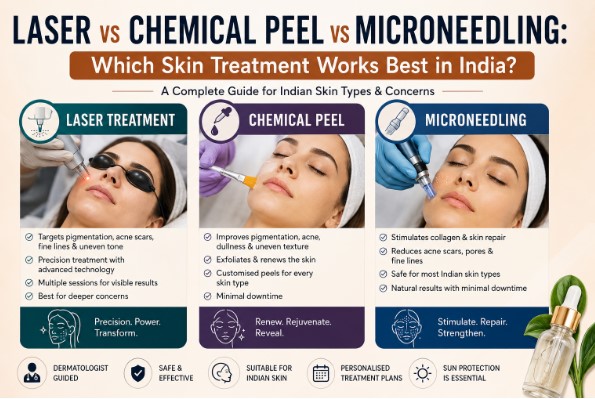

Walk into almost any dermatology clinic in India today — whether in Mumbai, Jaipur, Udaipur, Bengaluru, or smaller Tier 2 cities — and you will hear a similar question:
Which treatment actually works best?
LASER treatment, chemical peels, and microneedling are among the most commonly recommended skin procedures in India. All three can help improve concerns like pigmentation, acne scars, uneven texture, and signs of ageing. Yet they work very differently, carry different recovery times, and behave differently on Indian skin tones.
The problem is that most online advice about aesthetic treatments is either oversimplified or based largely on lighter skin types that respond differently than Indian skin.
This guide explains:
- how each treatment works,
- what concerns it treats best,
- how it performs on Indian skin,
- and what patients should realistically expect before choosing a procedure.
Why Indian Skin Requires a Different Approach
Indian skin typically falls within Fitzpatrick skin types IV to VI, which means it contains higher melanin levels than lighter skin tones.
This matters because melanin-rich skin can react differently to heat, inflammation, and trauma.
As a result:
- aggressive treatments may trigger pigmentation,
- incorrect LASER settings can worsen dark patches,
- and improper aftercare may lead to post-inflammatory hyperpigmentation (PIH).
This is why no single treatment can be considered universally “best.”
The safest and most effective treatment depends on:
- skin type,
- medical history,
- pigmentation tendency,
- lifestyle,
- and the experience of the treating dermatologist.
LASER Treatment
How LASER Treatments Work
LASER treatments use focused light energy to target specific concerns within the skin.
Different LASER wavelengths may target:
- pigmentation,
- redness,
- hair follicles,
- collagen stimulation,
- or scar tissue.
Some LASERs work on the surface, while others work deeper below the skin.
Types of LASER Treatments
Ablative LASERs
Ablative LASERs remove controlled layers of skin and are often used for:
- acne scars,
- wrinkles,
- and texture correction.
These procedures usually involve:
- longer downtime,
- more intense recovery,
- and higher pigmentation risk for darker skin tones.
Non-Ablative LASERs
Non-ablative LASERs work below the skin surface without removing the top layer.
They are often used for:
- pigmentation,
- skin rejuvenation,
- redness,
- and collagen stimulation.
Some non-ablative options are considered safer for Indian skin when performed correctly.
Fractional LASERs
Fractional LASER technology treats microscopic sections of skin while leaving surrounding tissue intact.
This approach may help:
- reduce downtime,
- support faster healing,
- and improve scar treatment outcomes.
What LASER Treatments Can Help With
LASER procedures may help improve:
- acne scars,
- pigmentation,
- uneven skin tone,
- sun damage,
- fine lines,
- enlarged pores,
- and certain vascular concerns.
However, most patients require multiple sessions for noticeable improvement.
Important Considerations for Indian Skin
Indian skin can respond strongly to heat-based procedures.
Patients should be cautious if they:
- have recent tanning,
- are prone to pigmentation,
- have active skin infections,
- or are using certain acne medications such as isotretinoin.
Sun protection after LASER treatment is extremely important, especially in climates with strong UV exposure.
Chemical Peels
How Chemical Peels Work
Chemical peels use carefully selected acids to exfoliate damaged outer skin layers and encourage skin renewal.
Different peels work at different depths:
- superficial,
- medium,
- or deep.
In India, superficial and medium-depth peels are generally more commonly used due to safety and recovery considerations.
Common Chemical Peels Used in India
Glycolic Acid Peel
Often used for:
- dullness,
- uneven tone,
- mild pigmentation,
- and texture improvement.
Salicylic Acid Peel
Commonly recommended for:
- oily skin,
- acne-prone skin,
- and clogged pores.
Lactic Acid Peel
Usually considered gentler and often selected for:
- sensitive skin,
- mild pigmentation,
- and hydration support.
TCA Peel
Medium-depth TCA peels may help with:
- pigmentation,
- acne scars,
- and texture concerns,
but they require careful patient selection in darker skin tones.
What Chemical Peels Treat Best
Chemical peels are commonly used for:
- uneven skin tone,
- pigmentation,
- acne,
- mild acne scars,
- dullness,
- enlarged pores,
- and overall skin brightness.
For many Indian patients, chemical peels are often considered one of the most accessible and cost-effective treatment options.
Recovery and Expectations
Most peels require a series of sessions rather than a single treatment.
Patients may experience:
- mild peeling,
- dryness,
- temporary redness,
- or sensitivity after treatment.
Proper aftercare and sunscreen use are essential to reduce pigmentation risk.
Microneedling
How Microneedling Works
Microneedling uses fine needles to create controlled micro-injuries in the skin.
These tiny injuries stimulate:
- collagen production,
- skin repair,
- and tissue remodeling.
Unlike LASER resurfacing, microneedling works mechanically rather than through heat.
RF Microneedling
Radiofrequency (RF) microneedling combines traditional microneedling with radiofrequency energy delivered deeper into the skin.
It is often used for:
- acne scars,
- skin tightening,
- enlarged pores,
- and early skin laxity.
What Microneedling Treats Best
Microneedling is commonly recommended for:
- acne scars,
- enlarged pores,
- uneven texture,
- stretch marks,
- and collagen stimulation.
It may also be combined with topical treatments depending on the skin concern.
Why Microneedling Is Often Preferred for Indian Skin
One major advantage of microneedling is that it generally carries a lower risk of post-inflammatory pigmentation compared to aggressive heat-based procedures.
This makes it a commonly preferred option for:
- darker skin tones,
- acne scar treatment,
- and patients prone to pigmentation complications.
Recovery and Downtime
After microneedling, patients may experience:
- redness,
- mild swelling,
- and temporary skin sensitivity.
Most people recover within a few days, though multiple sessions are usually required for visible improvement.
Side-by-Side Comparison
| Concern | LASER | Chemical Peel | Microneedling |
| Acne scars | Strong results | Mild–moderate improvement | Strong results |
| Pigmentation | Effective with caution | Commonly recommended | Limited alone |
| Active acne | Useful in some cases | Very effective | Usually avoided |
| Downtime | Moderate–high | Mild–moderate | Mild |
| PIH risk in Indian skin | Moderate–high | Moderate | Lower |
| Texture improvement | Strong | Moderate | Strong |
| Sessions required | Multiple | Multiple | Multiple |
Which Treatment Is Best for Common Indian Skin Concerns?
Acne and Oily Skin
Chemical peels — particularly salicylic acid peels — are commonly recommended for active acne and oily skin management.
Post-Acne Pigmentation
Chemical peels combined with proper skincare and sunscreen are often effective for post-acne dark marks.
Acne Scars
Microneedling and fractional LASER treatments are both commonly used for acne scars, depending on scar type and skin tone.
Melasma
Melasma often requires combination treatment approaches rather than relying on one procedure alone.
Uneven Skin Texture and Enlarged Pores
Microneedling, RF microneedling, and certain LASER procedures may help improve texture concerns over time.
Why Choosing the Right Clinic Matters
The outcome of any aesthetic treatment depends heavily on:
- proper diagnosis,
- correct treatment selection,
- and experienced medical supervision.
The same treatment may produce excellent results in one patient and complications in another if performed incorrectly.
Before undergoing any procedure, patients should ensure:
- consultation is performed by a qualified dermatologist,
- realistic expectations are discussed,
- risks are explained clearly,
- and aftercare guidance is provided properly.
Frequently Asked Questions
Which treatment is safest for Indian skin?
The safest treatment depends on the individual’s skin type, concern, and medical history. Indian skin may be more prone to post-inflammatory pigmentation, so treatments should always be customized by an experienced dermatologist.
Is microneedling better than laser for acne scars?
For many Indian skin tones, microneedling is often considered a safer first-line option for acne scars because it carries a lower risk of pigmentation complications compared to aggressive laser resurfacing.
Are chemical peels safe for pigmentation?
Yes, when selected appropriately and performed under medical supervision, chemical peels can help improve uneven pigmentation and skin texture.
How many sessions are usually needed?
Most treatments require multiple sessions for visible improvement. The exact number depends on the skin concern, treatment type, and individual skin response.
Final Thoughts
There is no single treatment that works best for every skin concern.
The right choice depends on:
- your skin type,
- the specific issue being treated,
- downtime tolerance,
- budget,
- and long-term skin goals.
For Indian skin, careful treatment selection and experienced medical supervision are especially important because of the higher tendency toward pigmentation-related complications.
Understanding the strengths and limitations of each treatment allows patients to make safer and more informed decisions instead of relying on trends or unrealistic promises.
About the Author
Dr. Deepa Singh is a cosmetic dermatologist and aesthetic medicine specialist based in Udaipur. Her clinic focuses on medically supervised skin, laser, and aesthetic treatments with an emphasis on evidence-based care and Indian skin-specific treatment approaches.
Patients exploring advanced dermatology procedures can learn more about aesthetic and LASER skin treatment in Udaipur through the clinic’s educational resources.