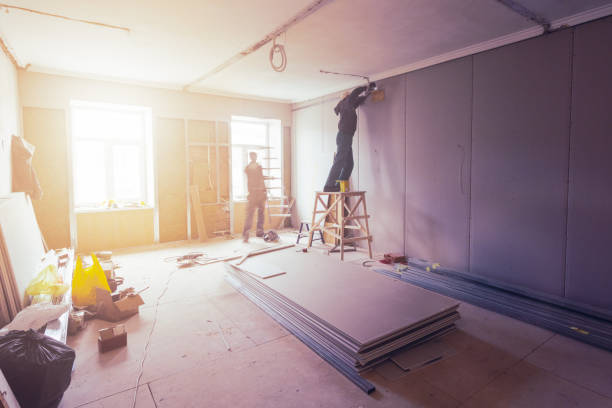

Not every home needs a gut renovation to feel dated. Sometimes it’s the layout that no longer makes sense, sometimes it’s finishes that were trendy fifteen years ago and now just look tired, and sometimes it’s simply that a house was built for a different way of living than the one happening inside it now. Modernizing a home doesn’t always mean starting from scratch — it usually means being strategic about which updates make the biggest difference.
Opening Up Closed-Off Floor Plans
Older homes were often designed with distinct, separated rooms — a formal dining room, a closed kitchen, a living room boxed off by walls on every side. Removing a non-load-bearing wall, or reinforcing a load-bearing one with a properly sized beam, can turn three cramped rooms into one open, functional space. This is consistently one of the most requested updates because it changes how a home feels to move through, not just how it looks.
Updating Flooring Throughout
Few things date a home faster than flooring — worn carpet, mismatched transitions between rooms, or tile patterns tied to a specific decade. Continuous flooring throughout the main living areas, whether that’s engineered hardwood or large-format tile, creates visual flow between rooms and makes a home feel considerably larger than it actually is. It’s also one of the more straightforward updates to execute without major structural disruption.
Kitchen Updates Without a Full Teardown
A complete kitchen remodel isn’t always necessary to modernize the space. Refacing or replacing cabinet doors, swapping outdated countertops for quartz, and updating hardware and lighting can transform a kitchen’s entire feel for a fraction of the cost of gutting it down to the studs. This approach works particularly well when the existing layout is functional and it’s really just the finishes that feel outdated.
Trim, Doors, and Millwork Details
This is one of the most overlooked categories, but it has an outsized effect. Swapping hollow-core doors for solid ones, updating baseboards and casing, and adding simple details like wainscoting or board-and-batten in an entryway all contribute to a home feeling more current without touching a single major system. These are also some of the more budget-friendly items on a remodeling list.
Lighting Design That Matches How Rooms Are Actually Used
A single central ceiling fixture per room was standard in home construction for decades, and it’s one of the clearest signs of an unrenovated interior. Layered lighting — recessed cans for general illumination, pendants over specific work areas, dimmers throughout — makes rooms feel intentionally designed rather than built to a basic code minimum. It’s a relatively low-cost category of work with a very visible payoff.
Paint and Finish Choices That Age Well
Bold accent walls and heavily saturated colors were a defining trend at various points, and they tend to date a home quickly once the trend passes. Neutral, warm-toned palettes paired with more distinctive fixtures, hardware, and textiles tend to hold up better over time, since the personality of a room comes from elements that are easier and cheaper to swap out later than an entire wall of paint.
A knowledgeable team offering full-scope interior remodeling services typically walks through these categories together during planning, rather than tackling them piecemeal, since decisions in one area — flooring, for example — often affect choices in another, like trim height or transition strips between rooms.
Working Room by Room vs. All at Once
Budget usually dictates whether a home gets modernized all at once or room by room over a longer period. Doing it in phases isn’t a compromise as long as there’s a cohesive plan guiding the choices — matching flooring, a consistent trim style, a paint palette that carries through connected spaces. Without that plan, phased renovations can end up feeling disjointed, like different decades stitched together under one roof.
Finding the Right Team for the Job
Interior updates touch a wide range of trades — flooring installers, electricians for lighting work, carpenters for trim and millwork, painters — and coordinating all of it separately as a homeowner is often more stressful than it needs to be. A company offering coordinated interior remodeling services manages that scheduling and sequencing so the work happens in a logical order instead of trades tripping over each other or redoing work because something was installed out of sequence.
Modernizing a home is rarely about one dramatic change. It’s the accumulation of smart, connected decisions — an open floor plan, consistent flooring, updated lighting, and finishes that won’t look dated again in five years. Approached thoughtfully, even a home built decades ago can feel completely current without an enormous budget or a full teardown.